Lockheed PV-1 1:48 Scale Revell Model Kit #85-5531 Review
2014 May 27
by Doug

Right On Replicas Step-by-Step Review 20140527*
Lockheed PV-1  1:48 Scale Revell Model Kit #85-5531 Review
000

Review and Photos by Kevin Lawton Kevin Lawton Thumbnail

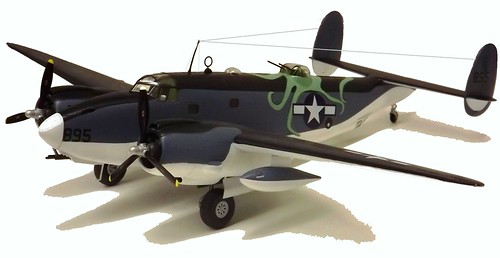
The PV-1 Ventura, was built for the U.S. Navy by the Vega Aircraft Company division of Lockheed (hence the “V” Navy manufacturer’s letter that later replaced the “O” for Lockheed).  The PV-1 Ventura actually began life as the B-34 Lexington, a medium bomber for the U.S. Army Air Forces.  However, during the early months of 1942, the primary responsibility for anti-submarine warfare in the United States was shouldered by the Army Air Force. This irked the Navy, as it considered this region of battle its burden.  A deal was struck between the Army and Navy when the Army needed the Navy’s Renton Washington plant to build its new B-29 Superfortress.  One clause in the deal stated that the Army would cease production of its B-34’s and B-37’s and that these resources would be used to build a Navy version of the B-34 – the PV-1 Ventura


For the Modeler: This review is based on the Lockheed PV-1, 1:48 Scale Revell Model Kit #85-5531. It is a skill level kit and contains 143 parts molded in light gray and clear “glass” pieces. This kit features recessed panel line detail, an optional “chin gun”, a movable bomb bay compartment with full load, separate wing tanks and decals for three versions: 1. U.S. Navy PV-1, BuNo. 48895, Patrol Bombing Squadron VP-133, Iwo Jima, 1945; 2. U.S. Navy PV-1, BuNo. 48891, Pilot Lt. “Butch” Mason, Patrol Bombing Squadron VP-135, Attu, Alaska, 1943 and R.C.A.F. Ventura of No. 149 Squadron, Prince Rupert, British Columbia, 1943.. Finished dimensions are: Wingspan: 16-1/4″, Length: 12-13/16″, Height: 3-1/4″. Here we have a bit of a discrepancy with the Revell kit as the kit is titled a PV-1, but if you build and decal the version (like I did) of “U.S. Navy PV-1, BuNo. 48895, Patrol Bombing Squadron VP-133, Iwo Jima, 1945”, I believe you are actually building a PV-2.  The PV-2 was armed with five 50 caliber (12.7 mm) machine guns in the nose, two in the upper nose decking and three in a chin pod; two 50 caliber machine guns in the Martin dorsal turret; and two 50 caliber machine guns in the ventral turret.[i]  I may be confused here, but based on the armament and the info complied at the web site (footnoted) I’d say it’s a PV-2 and PV-2’s were referred to as PV-2 Neptunes1.  OK, enough with the nit-picking let’s get on with the build.


Covered in this Review: If you want to perfect your build; basic construction; preparing parts for better finishing; alternate assembly sequence suggestions for fit and ease of finishing; complete paint and adhesive selections and applications; test fitting; contest considerations are discussed throughout; sink, tab and mold seam identification; version considerations and determinations; using an aftermarket mask for the canopy detailing; cockpit construction and detailing; using sprue as a construction aid; using Future to prevent decal silvering; scratch building gauge dials; adding detail to engine the nacelles; detailing the props; highlighting the fuselage wiring; engine detailing; authentic ordinance detailing; machine  gun detailing; using a liquid mask to complete the canopy masking; masking with Blu-Tac; masking and painting the fuselage for a multi-color scheme; scratch building some of the machine guns for added detail; scratch building the rudder masks; using decal setting solution; working with large decals; antennae rigging;  correcting instruction errors; decal preparation and application; are all fully examined in this expanded  19 page, full-color Step-by-Step review in PDF format.


100% money back guarantee!

Click the Buy Now link below to purchase the full Step-by-Step review for  $4.95 USD.


Important – You MUST click on the “Return to Right on Replicas, LLC” link after you’ve made your purchase to download your review!


Right On Replicas, LLC ©2014 All rights reserved.

*All registered trademarks are the property of their respective brands.


Hawaiian Charger Funny Car 1:16 Scale Revell Model Kit #85-4082 Review

2014 May 19
by Doug

Right On Replicas, LLC Step-by-Step Review 20140519*
Hawaiian Charger Funny Car 1:16 Scale Revell Model Kit #85-4082 Review
000

Review and Photos by Alan Mann Alan Mann (Thumbnail)

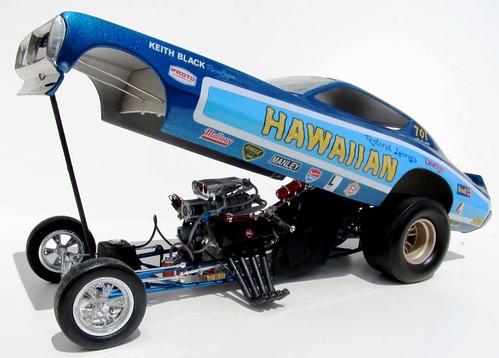
Roland Leong owned and maintained a stable of “Hawaiian” Top Fuel and Funny Car vehicles. With a succession of top drivers, his vehicles won drag races all over the country. In 1969 Leong abandoned his Top Fuel Dragster teams in favor of the burgeoning Funny Car class. The following year, with driver Larry Reyes, Leong ran a 1970 Dodge Charger AA/Funny Car that won its class at the 1970 NHRA Winter Nationals. In 1971, Leong’s “Hawaiian” Funny Car repeated at Pomona, winning Funny Car Eliminator again, this time with Butch Maas driving. In 1973 Leong teamed up with Revell as a sponsor. Throughout the 1970s and into the early 1980s, Leong campaigned a variety of “Hawaiian” Funny Cars, both in NHRA competition, as well as “match racing” at smaller, independent tracks. With so many legendary wins, Revell had to have a model of the Hawaiian Charger Funny Car. These kits took the modeling world by storm in a wave that rivaled the real car’s success.


For the modeler: This review is based on the Revell # 85-4082 Hawaiian Charger Funny Car. This kit is 1/16 Scale Skill level 3 for the Advanced builder and contains 154 parts. The kit is molded in White, Clear and Chrome and has Vinyl Tires and includes Vinyl Tubing and Wires for engine detailing. This kit has seen a few different box-art designs over the years and has had multiple re-issues: this is a 100% Reissue (Re-Pop). The original kit has had almost no changes in any releases besides decals. The copyright stamp on the chassis reads 1988 and the decals read 2014, so this is still based on the original molds. We have seen this as the Chi-Town Hustler, Gene Snow and other versions of the Hawaiian. Based on research I could find no real car that used these graphics so I would guess Revell took a tad bit of “Artistic License” with this release replicating a possible 1971-72 paint version. The motor is very detailed and includes tubing to wire and run lines it is almost a model in its own right. The rail chassis is well designed and fits together nice. The body is showing its age with some strong mold lines but it’s solid and straight. The decals look nice and are Revell’s top quality even if they are sort of “Phantom” set that probably was never seen on the real car. Revell took a collected design of the real cars to create this set. This release has both the Centerline style rims and the American Racing style rims but only the American Racing rims fit the tires. The tires are unbranded but research shows many times Leong ran plain black-walled tires so this could be considered correct. Overall dimensions of the finished build are: Length: 11-15/16″, Width: 4-3/16″, Height: 3-1/4″.


Covered in this Review:  If you want to perfect your build; basic construction; preparing parts for better finishing; alternate assembly sequence suggestions for fit and ease of finishing; complete paint and adhesive selections and applications; test fitting; contest considerations are discussed throughout; sink, tab and mold seam identification; suspension construction; detailing the tires for realism; removing the molded trademark scripts; removing unwanted chrome; motor construction, wiring and detailing; effective placement point  connectors; blower assembly and finishing; missing decals are identified; scratch builder some key missing arts; frame assembly construction and detailing; repairing warped parts; adding superglue to joints for strength; thorough steering linkage construction notes; highly detailed close-up photos; version considerations; detailing the tires/wheels for authenticity; detailed brake line construction; using foil for chrome accents; spraying metallic’s with the airbrush issues and corrections; setting the windows in place; extra wheel notes; correcting instruction errors; decal preparation and application; are all fully examined in this gigantic  28 page, full-color Step-by-Step review in PDF format.


100% money back guarantee!


Click the Buy Now link below to purchase the full Step-by-Step review for  $3.95 USD.

Important – You MUST click on the “Return to Right on Replicas, LLC” link after you’ve made your purchase to download your review!


Right On Replicas, LLC ©2014 All rights reserved.

*All registered trademarks are the property of their respective brands.

 

Build a Model of Your Local Fire Chief’s Car (1976 Chevy Caprice) 1:25 Scale MPC Model Kit #753/12 Review

2014 May 17
by Doug

Right On Replicas, LLC Step-by-Step Review 20140517*
Build a Model of Your Local Fire Chief’s Car (Chevy Caprice) 1:25 Scale MPC Model Kit #753/12 Review
000

Review and Photos by Alan Mann Alan Mann (Thumbnail)

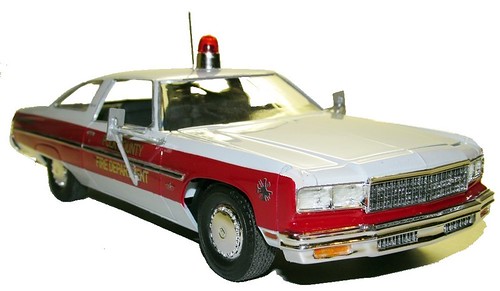
If you’ve ever thought that it might be cool to build a replica of the local fire emergency vehicle in your local area; you’re right and you’re not alone.  As many of the local vehicle markings become available , it is getting easier than ever to make your own.  The markings on this Polk County Florida Fire Department cruiser were available from one the numerous aftermarket decal makers that are described in the full review. You could even make all of the script on this vehicle with simple programs like Microsoft Paint or Word. The only trouble you might have is recreating the department emblems like the crest on the front quarter panel. For this you might have to ask nicely if you can take a photo of the emblem and use you ink jet or color laser printer to make them using some decal paper. The only other obstacle is making decals that are white.  If they are stripes you can carefully cut them from white decals paper or tape. If it’s white letters or scripts you need you can get them printed by an online custom decal printer This batch was made by one of them, or you can try to match the background shade of the car’s body color and print the white letters of the script in the middle of that on white decal paper.


For the Modeler: This is based on the 1976 Chevy Caprice MPC kit number 753/12 model in 1/25 scale recently re-released by Round 2 Models. This kit is still available at online model stores.  It is a Skill Level 2 kit for the average builder.  The kit is molded in White, Chrome, Clear, Red Clear and Vinyl Tires with metal axles with approximately 60 parts. The best part about this kit is that you can customize like this to produce some great period-correct specialty vehicles like a police or emergency vehicle with just a little extra decal and paint work. Shelf space is roughly 9 inches long 3 inches wide and 3 inches tall. The kit comes with a Tilt Bed Trailer that is not reviewed here. The trailer parts count is not included in the parts count of 60 parts. This kit has seen multiple releases, it started life as a 1974 Annual became a 1975 Annual and a 1976 Annual plus all the other re-releases through the years. The latest rendition is still the same kit with new decals to create an Auto World race car hauler. Being an earlier kit from the 70s it is simplified and still holds some of its Promo style quirks, like screw holes in the chassis that were filled in but never really removed. The kit itself is basic and detail is thin on the interior and the motor is bland and generic. Typical for its time, many of the motor parts are Chrome that should not be. The chassis is simplified and basic, but does have decent detail.  The body is showing its age, the hood does not fit and other than the side molding the trim work is very shallow. Round 2 has done so much to bring back the oldies we loved to build in the past, this is yet another one of the favorites. But it seems they did not spend the time to make it as good as the “Retro Deluxe” kits released in recent history.


Covered in this Review:  If you want to perfect your build; basic construction; preparing parts for better finishing; alternate assembly sequence suggestions for fit and ease of finishing; custom decal sources and methods; repairing warped parts; removing unwanted chrome form parts; engine construction and detailing:  complete paint and adhesive selections and applications; test fitting; contest considerations are discussed; sink, tab and mold seam identification; chassis and  suspension construction; paint masking techniques; detailing the firewall and window trim with a Sharpie pen; interior detailing and finishing; detailing the tires for realism; removing the molded trademark scripts; correcting instruction errors; decal preparation and application; are all fully examined in this pictorial 16 page, full-color Step-by-Step review in PDF format.


100% money back guarantee!

Click the Buy Now link below to purchase the full Step-by-Step review for  $3.95 USD.


Important – You MUST click on the “Return to Right on Replicas, LLC” link after you’ve made your purchase to download your review!


Right On Replicas, LLC ©2014 All rights reserved.

*All registered trademarks are the property of their respective brands.