Aerobee-Hi Research Rocket 1:40 Scale Revell Kit #H-1814 Review

2013 May 29
by Doug

RoR Step-by-Step Review 20130529*
Aerobee-Hi Research Rocket 1:40 Scale Revell Kit #H-1814 Review
photo-000
 

Click the Buy Now link below to purchase the 13 page Step-by-Step review by Bill Pierce Bill Pierce Thumbnail

Built by Aerojet-General Corporation, the Aerobee Hi claimed the record for single stage boosted rockets on April 30 1957. Designed to carry heavy payloads to higher altitudes than the Aerobee 170, this rocket set a new record altitude for single stage rockets on April 30, 1957 when it carried 140 pounds to a height of 180 miles above White Sands. Equipment for America’s first satellite was tested by sending it aloft on an Aerobee. The Aerobee Hi rockets were launched from the White Sands proving ground and Holloman Air Force Base in New Mexico, the U.S.S. Norton Sound off the coasts of Alaska and Peru and from the special Aerojet built IGY (International Geophysical Year) launching facility at Fort Churchill, Manitoba, Canada. The Aerobee Hi was a “free flight” rocket that was free from many of the mechanical troubles that plague more complicated controlled missiles. Much of the research aided in man’s eventual trip to the Moon.

For the Modeler: This is a Revell skill level 1, 1:40 scale Aerobee-Hi Research Rocket model kit #H-1814. This Revell kit was originally released in 1958 as the International Geophysical Year was drawing to a close and this kit was re-issued in 1996. Although they are no longer in production they are still available at online auction sites and garage sales. The mold does show its age in a few areas. The kit contains about 35 pieces molded in gray and white plastic with three crew members, a waterslide decal sheet, and instructions in English. Finished overall dimensions are; Length: 12.5″, Width: 3.125″, Height: 2.25″.

Covered in this Review: If you want to perfect your build; basic construction; preparing parts for better finishing; adhesive selections and applications; seam identification and repairs; paint selection and application; repairing flash; crew figure finishing; rocket body assembly techniques; test fitting; aligning the stages; alternate assembly sequences to preserve fragile parts; repairing wheel seams; are all fully examined in this 13 page, full-color Step-by-Step review.


 Important – You MUST click on the “Return to Right on Replicas, LLC” link after you’ve made your purchase to download your review!


To get your copy of the full review – just select one of the payment methods above for $4.99 USD.

 
Right On Replicas, LLC ©2013 All rights reserved.
*All registered trademarks are the property of their respective brands.

AMTronic 1:25 Scale AMT Kit #755 Review

2013 May 28
by Doug

RoR Step-by-Step Review 20130528*
AMTronic 1:25 Scale AMT Kit #755 Review
Click here to buy this kit through Amazon.com

DSC00000


Click the Buy Now link below to purchase the 17 page Step-by-Step review by James Yeager James Yaeger II Thumbnail

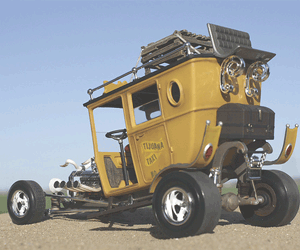
The AMTronic is the car of the future as thought it would look like back in 1969. AMT created this iconic concept model kit in 1969 after a Detroit car show and has only been released three times starting in 1969 than in 2000 and again in 2012. The box art for this kit is from the original release AMT T363 returning the cool artwork that was originally designed for this kit. This concept vehicle is two cars in one and does not stop there with all the available options!

For the Modeler: This is AMT’s futuristic car known as the AMTronic which is 1/25th scale. The kit was molded in grey, chrome, clear, black vinyl tires and green tinted clear. There are around 150 parts for this model kit and it does not look like any of the kit was retooled from the original molds back in the 60’s.The skill level has changed from the skill level 2 in 2000 to a skill level 3 in 2012. With the base that comes with this kit it measures 11inches long by 9 3/8 inches wide and 5 ¼ inches high. Without it’s paper base the kit measures 10“ long by 3¼“ wide and 2⅛” high.

Covered in this Review: If you want to perfect your build; basic construction; preparing parts for better finishing; adhesive selections and applications; altered assembly sequence suggestions; flash identification and repairs; paint selection and application; engine construction, painting, and detailing; ensuring free-wheeling fan rotor and door hinge construction; working with the door enclosures; masking and reducing canopy bleed-through and clean-up techniques; working with fragile parts; toothpick glue applicator method; wheel fairing and gull-wing door modifications for fit; and constructing the display stand are all fully examined in this comprehensive 17 page, full-color Step-by-Step review.


To get your copy of the full review – just select one of the payment methods above for $4.99 USD.

Right On Replicas, LLC ©2013 All rights reserved.
*All registered trademarks are the property of their respective brands.


Mosquito Mk IV 1:48 Scale Revell Kit #85-5320 Review

2013 May 22
by Doug

RoR Step-by-Step Review 20130522*
Mosquito Mk IV 1:48 Scale Revell Kit #85-5320 Review
Click here to buy this kit through Amazon.com

000
 

Click the Buy Now link below to purchase the 12 page Step-by-Step review by Kevin Lawton Kevin Lawton Thumbnail

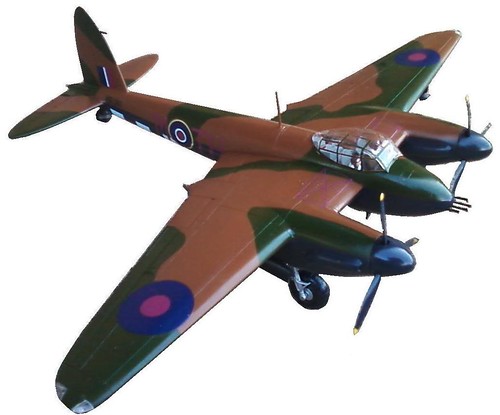
The de Havilland DH.98 Mosquito was a British multi-role combat aircraft, with a two-man crew, that served during the Second World War and the postwar era. The Mosquito was one of the few operational, front-line aircraft of the World War II era to be constructed almost entirely of wood and, as such, was nicknamed “The Wooden Wonder”. The Mosquito was also known affectionately as the “Mossie” to its crews Originally conceived as an unarmed fast bomber, the Mosquito was adapted to many other roles during the air war, including: low- to medium-altitude daytime tactical bomber, high-altitude night bomber, pathfinder, day or night fighter, fighter-bomber, intruder, maritime strike aircraft, and fast photo-reconnaissance aircraft. It was also used by the British Overseas Airways Corporation (BOAC) as a transport.

For the Modeler: This is a Revell skill level 2, 1:48 scale de Havilland DH.98 Mosquito Mk IV model kit. This version of Revell’s Mosquito Mk IV is the 1966 mold and as such does show its age in a few areas. The kit contains about 103 pieces molded in grey plastic, 12 in clear plastic, and a decal sheet covering three Royal Canadian Air Force aircraft. Kit features a choice of three versions (bomber, night fighter or fighter/bomber), optional bomb bay doors, pilot and navigator figures. I built the kit version that represents the 418 Sqn. FB.VI of the Canadian Air force here. Finished dimensions are; Length: 10-1/8″, Wingspan: 13-1/2″, Height: 3″.

Covered in this Review: If you want to perfect your build; basic construction; preparing parts for better finishing; adhesive selections and applications; alternate assembly sequence suggestions for fit and ease of finishing; seam identification and repairs; paint selection and application; repairing flash; version modifications and considerations; cockpit detailing, aviator figures finish selections; fuselage assembly techniques; canopy finishing; exterior color choices and putty masks; ordinance color selections; decal application techniques; realistic gun barrel finishing and expanded 1:1 history are all fully examined in this 12 page, full-color Step-by-Step review.

 Important! – You MUST click on the “Return to Right on Replicas, LLC” link after you’ve made your purchase to download your review!


To get your copy of the full review – just select one of the payment methods above for $2.99 USD.


Right On Replicas, LLC ©2013 All rights reserved.
*All registered trademarks are the property of their respective brands.